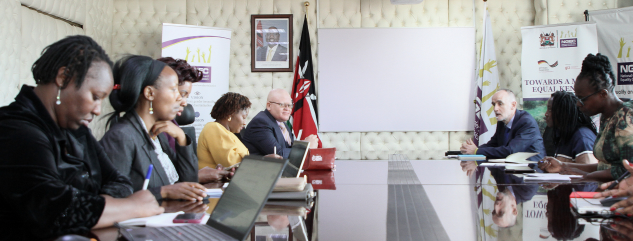
The National Gender and Equality Commission (NGEC) masked a deeper strategic dialogue—one that could shape Kenya’s approach to tackling entrenched inequalities. Mr. Frank Holtmeier of GIZ Kenya (Deutsche Gesellschaft für Internationale Zusammenarbeit GmbH) met with Commission officials in what turned out to be a decisive exchange on aligning international expertise with national priorities for inclusive development.
At the centre of discussions was the National Inequality Reduction Action Plan, a blueprint designed to confront inequality not as an abstract concept but as a tangible barrier to opportunity across education, employment, political participation, and access to essential services.
Kenya’s inequality is complex, unevenly distributed, and deeply rooted. Children with disabilities still struggle to access inclusive education. Women and youth remain concentrated in informal, low paying work. Political leadership often fails to reflect the country’s diversity. The meeting underscored that addressing these gaps requires more than policy statements —it demands coordinated, actionable strategies grounded in data and evidence.
Both NGEC and GIZ Kenya agreed that strategic alignment is key. Rather than fragmented projects, technical cooperation must reinforce national systems, empower institutions, and strengthen mechanisms for monitoring impact. This ensures that interventions do more than tick boxes— they deliver measurable improvements in the lives of Kenya’s most marginalized communities, including women, youth, persons with disabilities, children, older persons, minorities, and other vulnerable groups.
GIZ Kenya brings decades of experience supporting inclusive governance, social protection, and sustainable development across Africa.
For NGEC, this engagement represents an opportunity to amplify the Commission’s mandate: promoting equality, inclusion, and human rights through evidence-based interventions. The discussion also positioned equality as an economic and democratic imperative. Persistent disparities weaken trust in institutions, limit social cohesion, and constrain economic growth. Conversely, inclusive development strengthens governance, unlocks productivity, and builds resilience against social and economic shocks.
This partnership signals a strategic shift—an acknowledgement that tackling inequality requires deliberate, long-term collaboration.