NAIROBI, Kenya — Every school day, thousands of children navigate busy roads, informal settlements and congested neighbourhoods to reach classrooms, often sharing narrow streets with speeding vehicles, motorcycles and heavy traffic. For many families, the journey to school has become one of the most dangerous parts of a child's day.
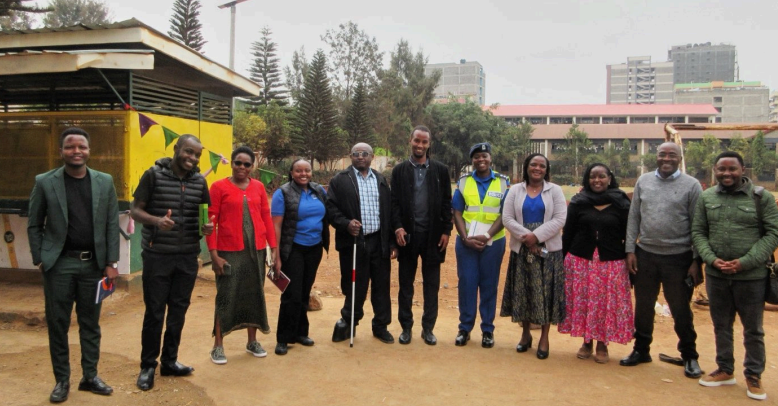
It is against this backdrop that the National Gender and Equality Commission (NGEC), working with the Japan International Cooperation Agency (JICA), the National Police Service (NPS) and other government agencies, has initiated a community-based road safety education programme in Mukuru aimed at reducing preventable road traffic injuries involving children.
The programme, whose planning commenced at the Mukuru Community Centre, seeks to strengthen road safety awareness among children, parents, caregivers, teachers and community stakeholders while promoting greater accountability among motorists, motorcycle operators and institutions responsible for road safety. The initiative comes as road safety continues to emerge as one of Kenya's most pressing public health and child protection challenges. According to data released by the National Transport and Safety Authority (NTSA), pedestrians remain the most affected category of road users in fatal crashes.
Between January and March 2025 alone, 420 pedestrians lost their lives, the highest number among all road user groups, while 301 motorcyclists also died during the same period.
National data further indicates that pedestrian fatalities continue to outnumber those of motorists, passengers and cyclists. In 2025, 1,889 pedestrians were killed on Kenyan roads, underscoring the disproportionate risks faced by people travelling on foot, including school-going children.
While infrastructure improvements such as sidewalks, pedestrian crossings, and speed-calming measures have expanded in many urban areas, stakeholders increasingly argue that infrastructure alone cannot guarantee children's safety.
One of the growing concerns discussed during the planning engagement is the increasing misuse of pedestrian walkways by motorcycles, commonly known as boda bodas. Across many urban centres, motorcycles routinely ride on pavements, use pedestrian walkways as alternative routes during traffic congestion and travel against the flow of traffic, exposing children, older persons and persons with disabilities to unnecessary danger.
The National Transport and Safety Authority has repeatedly cautioned motorcycle operators against using pedestrian walkways, emphasising that these facilities are reserved exclusively for people on foot.
The Authority has warned that the growing encroachment of walkways by motorcycles is undermining pedestrian safety and eroding one of the most important protective features of urban road infrastructure. The issue has also attracted increasing policy attention. Recent traffic enforcement measures classify driving on pavements and pedestrian walkways as a traffic offence, attracting penalties intended to discourage behaviour that places vulnerable road users at risk.
Road safety experts note that children are particularly vulnerable because they have limited ability to accurately judge vehicle speed, distance and driver behaviour. Younger pedestrians may act impulsively, have restricted visibility in busy traffic environments and depend heavily on adults and motorists to anticipate and reduce potential hazards.
The Mukuru initiative therefore adopts a broader approach to child safety by recognising that preventing road traffic injuries requires behavioural change alongside infrastructure development.
Children participating in the programme will receive practical road safety education, including how to safely cross roads, identify potential hazards, interpret traffic signs and navigate busy junctions. Parents and caregivers will be sensitised on supervising children during school journeys and reinforcing safe road practices at home, while teachers and community leaders will be supported to integrate road safety awareness into everyday interactions with learners.
The collaboration between NGEC, JICA, the National Police Service and other government agencies also reflects a growing shift towards preventive approaches in child protection.