NAIROBI
Kenya’s constitutional and statutory commissions continue to record significant gaps in compliance with legal requirements on equality and inclusion, with persons with disabilities emerging as the most excluded group in senior public institutions.
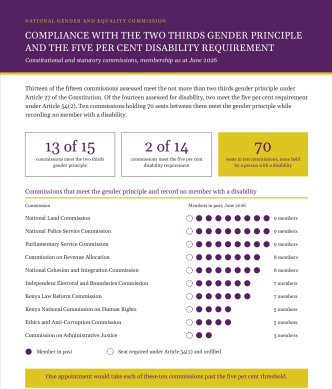
An assessment by the National Gender and Equality Commission found that only two of the 14 commissions that submitted data on membership of persons with disabilities met the constitutional and statutory threshold requiring at least five per cent representation. The assessment covered 15 constitutionaland statutory commissions and was based on membership data available as at June 2026.
The National Gender and Equality Commission and the Public Service Commission were the two institutions that met threshold, with persons with disabilities accounting for 20 per cent and 12.5 per cent of their respective memberships.
THE GENDER PICTURE
Across the 15 institutions there were 113 serving commission members, comprising 59 men, 53 women and one intersex person. Women accounted for 46.9 per cent of membership overall. Thirteen of the 15 commissions, or 87 per cent, complied with the constitutional requirement that no more than two-thirds of members be of the same gender.
Two commissions were found to be non-compliant. The Judicial Service Commission had nine women and three men, placing women at 75 per cent of its membership, while the Salaries and Remuneration Commission had eight men and three women, placing men at 72.7 per cent.
THE DISABILITY PICTURE
The assessment recorded no persons with disabilities among the members of 12 of the 14 commissions that provided disability data. The Judicial Service Commission, National Police Service Commission, National Land Commission, Parliamentary Service Commission, Salaries and Remuneration Commission, National Cohesion and Integration Commission, Kenya National Commission on Human Rights, Commission on Revenue Allocation, Independent Electoral and Boundaries Commission, Commission on Administrative Justice, Kenya Law Reform Commission and Ethics and Anti-Corruption Commission each recorded zero representation. The Teachers Service Commission was excluded from the disability analysis because it did not submit data on its commission membership.
ETHNICITY AND COMPOSITION
Ethnic representation across the institutions was relatively broad, with 22 communities represented, including smaller communities such as the Illchamus, Pokomo, Bajun and Gabra. Even so, 53 per cent of commission members came from four communities: Luo, Kikuyu, Luhya and Kalenjin.
The assessment also identified vacancies and incomplete statutory composition. Of the 15 institutions assessed, 10 were optimally constituted while five operated with fewer members than prescribed by their establishing legislation. These were the Kenya Law Reform Commission, Parliamentary Service Commission, Public Service Commission, Salaries and Remuneration Commission and Teachers Service Commission.
WHAT THE COMMISSION HAS RECOMMENDED
NGEC has recommended that appointing and vetting authorities ensure future appointments comply with Article 27 of the Constitution, including the two-thirds gender principle, while giving effect to Article 54(2) on the representation of persons with disabilities. The Commission has further called for greater ethnic diversity, including representation of minorities and marginalised communities, and for vacancies to be filled expeditiously so that institutions operate at their prescribed strength.
APPOINTMENTS MADE AFTER THE ASSESSMENT
On 31 August 2026 the President appointed Flora Nduku Mutua as a member of the Public Service Commission for a six-year term. The same Gazette notice appointed Antonina Lentoijoni and Wilson Sossion as members of the Teachers Service Commission, also for six years. Both institutions had been identified in the assessment as operating below their prescribed statutory composition as at June 2026, the Teachers Service Commission with two reported exits and the Public Service Commission with one vacancy.
The appointments reinforce the case for continuous monitoring, so that the filling of vacancies also advances constitutional requirements on gender equality, disability inclusion, diversity and non-discrimination.
.JPG)