Eleven of 35 buildings audited by the National Gender and Equality Commission carry that single word in the Commission’s own table. They are the places where Kenyans register a birth, obtain a title deed, file a case, pay tax and seek treatment.
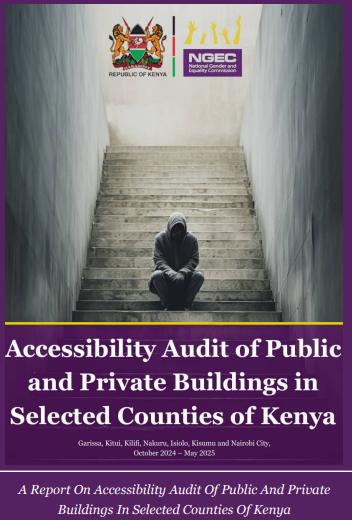
At the Garissa County Government headquarters there is a ramp. It serves the back fire exit. To reach the principal offices, including the Governor’s, a visitor must take the stairs. These findings come from an accessibility audit conducted by the National Gender and Equality Commission in 35 buildings across seven counties between October 2024 and May 2025. Fourteen buildings were rated accessible, ten somewhat accessible and eleven inaccessible.
At the Office of the Attorney General in Malindi, the services are upstairs. There is no lift and no ramp. The same holds at the State Department for Labour in the same complex, and at the Social Health Authority offices at Barani Plaza, where residents go to sort out their health cover. At Huduma Centre Kitui the approach route is accessible, the corridors are wide and the counters are set at the correct height. The walk-through metal detector at the entrance is too narrow for a wheelchair.
The audit was undertaken under Sections 8(e) and 8(m) of the NGEC Act, Cap 7K, and anchored on the principles of universal design and reasonable accommodation set out in the Convention on the Rights of Persons with Disabilities, the African Charter protocol on the rights of persons with disabilities of 2018, Article 54 of the Constitution, the Persons with Disabilities Act of 2025, the National Building Code of 2004 and the National Policy for Persons with Disabilities of 2024. Eight parameters were assessed by physical observation using a standard monitoring tool: approach routes, alternative entrances, tactile walking surfaces, circulation space for wheelchair and white cane users, accessible washrooms, service counters, accessible parking and signage.
The exercise followed a petition by a civil society organisation representing persons with disabilities in Mombasa. The Commission issued an advisory to the Mombasa County Government seeking compliance, then set out to establish what conditions prevailed elsewhere.
Certain failures recurred in almost every county. Tactile walking surfaces, the raised paving that allows a white cane user to navigate independently, appear in five of the 35 buildings. Braille signage was inadequate across nearly all counties, and where signage existed it carried no braille or tactile indicator. Kenyatta National Hospital and the Mercure Hotel in Nairobi have visible signage, without braille.
Service counters were mostly set too high. The accessible range is 740mm to 800mm from the floor with clear knee space underneath, so that a wheelchair user or a person of short stature can be served face to face. Compliant counters were found at Kitui Huduma Centre, the casualty area at Isiolo Referral Hospital and Kisumu Law Courts. Accessible washrooms were rare, and Garissa County Government offices, the Malindi offices and Nakuru Law Courts had none. Reserved parking was largely absent, and where it existed the marking and the distance from the entrance still required improvement. Reserved seating in waiting halls was found in two buildings. The International Symbol of Accessibility was applied consistently in three.
In Garissa, the Regional Commissioner’s offices were rated inaccessible, with a steep ramp, no ramps to upper floors, no alternative entrance and no accessible counter. A conference facility has ramps on the ground floor and none to the main hall upstairs. The Level 5 referral hospital and a private hospital were rated accessible. In Kitui, the Municipality Block was rated inaccessible, with no ramp from the ground floor to the service area and no space for wheelchairs. The County Survey Office has a narrow ramp without handrails.
The Civil Registration Building, by contrast, has wide corridors and a room dedicated to persons with disabilities, and was rated accessible. Every building assessed in Kilifi is privately owned and leased to public agencies. Three of the five were rated inaccessible. All three are multi-storey buildings with no lift and no ramp to the floor on which the service is delivered.