For many Kenyan families, transition to secondary school is supposed to be a moment of triumph. But this year, one teenager’s journey to the classroom became a national flashpoint — not because of what he achieved, but because of how the system failed him. After earning placement at one of the country’s prestigious national schools, a Grade 10 learner with a disability was initially denied admission, pushing his family into uncertainty and igniting public debate about inclusive education in Kenya.
The episode did more than shake one community; it prompted the National Gender and Equality Commission (NGEC) to launch an urgent, multi‑school fact‑finding mission. In visits that spanned Nairobi to Thika, the Commission found pockets of promise — where specialised support and accessible environments turn policy into progress — but also persistent systemic gaps that leave some learners on the margins of a system built to include them. Kenya’s education laws and policies position inclusive education as a constitutional right. The Basic Education Act and the Sector Policy for Learners and Trainees with Disabilities affirm that learners with disabilities should be able to attend mainstream schools alongside their peers, with appropriate support and reasonable accommodation.
Yet advocacy groups say the reality often falls short. The Institute for Social Accountability, for example, has criticised instances of exclusion — including recent cases where learners were denied admission because schools lacked disability‑friendly facilities — as violations of constitutional rights that deep‑root inequality and undermine access to education for vulnerable children.
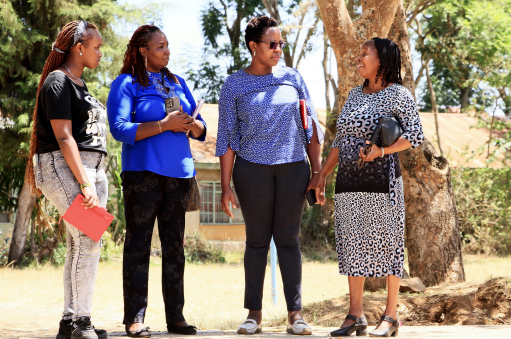
At Thika School for the Visually Impaired, the Commission found a school deeply committed to inclusion. The institution had 99 Grade 10 learners, the majority with visual impairments, supported by 40 teachers—all trained in special needs education. Over three days of assessments Commission teams engaged with institutions across Nairobi.
At Moi Forces Academy, officials discussed learner welfare and governance structures; at Aquinas High School, authorities acknowledged being open to inclusion but flagged the absence of specialised staff as a key limitation. At Ngara Girls High School and Upperhill High School, administrators described deliberate efforts towards inclusion, but noted that support systems remain inconsistent and under‑resourced.
The story shifted when teams reached specialised institutions like Thika School for the Blind and Salvation Army Joytown Special Primary School. In these environments, learners with disabilities demonstrated confidence and independence — outcomes observers attributed to purpose‑built infrastructure, sustained support services and tailored learning approaches. These schools offered a glimpse of what inclusive education can look like when intentions match resources and training.
According to the Ministry of Education, about 11.4 per cent of children aged 3–21 in Kenya live with disabilities — roughly 2.5 million learners.
But absence of accessible infrastructure, assistive learning materials and trained educators limits the ability of many schools to fulfil their constitutional obligation.
Despite significant government investment in education — with the sector receiving Sh628.6 billion in the 2023/24 national budget — allocations for Special Needs Education lag behind the need. Funding shortfalls have meant that capitation grants intended to support learners with disabilities often reach only a fraction of those targeted.
One of the most consistent themes emerging from school visits was the critical role of teachers. Educators trained in inclusive methodologies — especially those who themselves live with disabilities — were shown to be powerful agents of change, changing school cultures and modelling acceptance. Yet many teachers still lack access to specialised professional development, limiting their ability to adapt lessons and learning environments for diverse needs. Such training is essential if inclusion is to move beyond principle to everyday practice.
The Commission’s assessment also revealed how disability intersects with poverty, gender and geography to deepen educational exclusion. Girls with disabilities, in particular, face compounded barriers, including higher risks of school dropout and social marginalisation.
Children in remote or marginalised counties, where infrastructure and support services are often weakest, face even steeper challenges. The Commission’s assessment also revealed how disability intersects with poverty, gender and geography to deepen educational exclusion. Girls with disabilities, in particular, face compounded barriers, including higher risks of school dropout and social marginalisation. Children in remote or marginalised counties, where infrastructure and support services are often weakest, face even steeper challenges.
The NGEC’s consolidated findings will now inform recommendations for strengthening policy coherence, reinforcing accountability frameworks, expanding teacher training, and ensuring that schools are not only prepared but equipped to support learners with diverse needs. Inclusive education, the Commission emphasised, is not a rhetorical ideal but a constitutional right and national imperative.
Turning that right into reality requires deliberate investment, systemic coordination, and a shared national commitment. Kenya’s legal and policy frameworks remain among the most progressive in Africa. But the journey from policy to classroom reality is far from complete.
For learners and families who arrive at school gates with hope, inclusion must not be a conditional privilege. It must be a guarantee — reflected in accessible classrooms, supportive teachers, adaptive learning tools, and a school community that embraces every child. Only then can the promise of inclusion become more than a line in a policy document — and evolve into a lived reality for every learner.