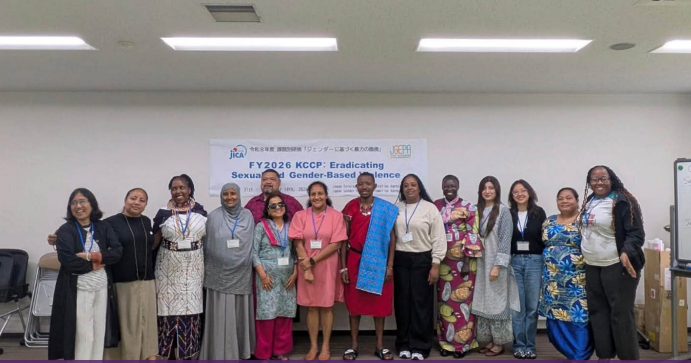
Kenya has presented the state of sexual and gender-based violence at county level to participants from 14 countries at the FY2026 Knowledge Co-Creation Program in Tokyo.
The programme, held at the JICA Centre, is facilitated by the Japan International Cooperation Agency (JICA) in partnership with the Japan Gender Equality Promotion Agency (JGEPA). It runs on the eradication of sexual and gender-based violence (SGBV) and brings participants together to compare experience and examine Japan’s approaches.
The National Gender and Equality Commission (NGEC) is represented by Mr Lewis Mwaniki, its Nakuru Regional Coordinator. The Commission is partnering with JICA to implement a programme on the eradication of SGBV in Kajiado, Machakos and Baringo counties.
KENYA’S TURN
Mwaniki presented on Monday alongside Ms Hellen from Kajiado County, setting out Kenya’s experiences, interventions, challenges and lessons at county level. Kenya pointed to the GBV Court in Shanzu and the Equality and Inclusion Technical Working Group among the measures it has put in place to strengthen prevention and response. Kenya also has much to learn from the approaches of the other countries taking part, the team noted.
LESSONS FROM JAPAN
Across the week participants worked with specialists and institutions from different corners of the field. JICA’s Senior Advisor on Gender and Development presented the agency’s initiatives against gender-based violence, and participants examined the legal frameworks that guide prevention and elimination.
A session on intimate partner violence, led by the Director of the Institute of Collaborative Practice, examined the dynamics of abuse inside intimate relationships. The discussion underlined that interventions must answer survivors’ immediate and long-term needs while confronting the social, cultural and structural factors that keep violence going.
At the Gender Equality Bureau in Japan’s Cabinet Office, Assistant Director Shiho Suzuki set out Japan’s measures against domestic and sexual violence, and the role of government in building legal, policy, prevention, protection and response mechanisms.
Survivors can remain at risk from perpetrators after they seek help. That took the participants to the Tokyo Metropolitan Women’s Consultation and Support Center, where they examined how the centre operates, the services available to survivors and the approaches Kenya could adapt for its own survivor-centred systems.
A social support centre visited later runs a hotline 24 hours a day, seven days a week. It has taken on several foreign languages widely spoken in Japan so that language does not stand between a survivor and help.
The week closed with Japan’s National Police Agency, which set out how Japanese police handle stalking and domestic violence, from risk prevention to survivor protection and institutional response.For Kenya, the lessons point to stronger institutions, coordinated interventions and more responsive systems for preventing and eliminating SGBV.
.JPG)