For every 100 people employed in Kenya’s public service, only two are persons with disabilities.
That is the starkest finding from the 21st cycle of Performance Contracting for the 2024/2025 financial year, evaluated by the National Gender and Equality Commission (NGEC). Across 88 public institutions that submitted returns, 1,828 of 93,506 employees were persons with disabilities, representing just 2 per cent of the workforce. The benchmark is 5 per cent. No sector came close.
Ministries and State departments recorded the highest proportion, at 2.6 per cent, followed by public universities at 2.5 per cent and State corporations at 1.8 per cent. Tertiary institutions recorded the lowest, at 0.9 per cent, equivalent to an average of only two employees with disabilities per institution.
The numbers reveal another layer of exclusion. Of the 1,828 employees with disabilities, 1,190 were men and only 638 were women. That means there were almost two men with disabilities in public employment for every woman. In tertiary institutions, the average number of women with disabilities per institution rounds down to zero.
The picture becomes more complicated when inclusion is measured beyond disability.People from minority and marginalised communities, as defined under Article 260 of the Constitution, occupied 6.3 per cent of the positions reported. But even this figure masks significant differences between sectors. State corporations accounted for the strongest representation at 8.4 per cent,while the three reporting ministries and state departments had only 14 employees from minority and marginalised communities among 5,803 staff, representing 0.2 per cent. Young people aged between 18 and 34 occupied 18.1 per cent of the positions overall.
Their representation ranged from 36.7 per cent in tertiary institutions to only 5.9 per cent in public universities. There is, however, one area where the public service is performing considerably better: overall gender balance. Eightyeight per cent of the reporting institutions complied with the constitutional requirement that neither gender should constitute more than two thirds of the workforce. All reporting ministries, State departments and public universities met the requirement. Women accounted for 39.9 per cent of the 93,506 employees measured, and were the majority only in tertiary institutions, where they represented 52.9 per cent.
The overall picture is therefore uneven. Gender balance is showing progress, while disability inclusion, representation of minority and marginalised communities, and youth representation remain considerably weaker. But there is an even bigger question behind these figures: how much of the public service do they actually represent? Only 88 institutions submitted returns for the 21st cycle. The number was 201 in 2023/2024 and 390 in 2022/2023. In other words, the number of institutions reporting has fallen sharply.
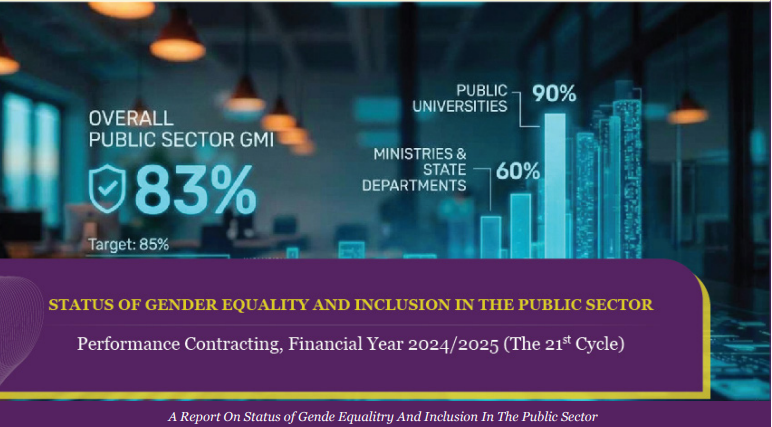
That matters because the overall Gender Mainstreaming and Inclusion index scored 83 per cent, only two points below the 85 per cent target.The score may appear encouraging, but it reflects only the institutions that reported. It tells us nothing about those that did not. The fewer institutions that report, the harder it becomes to know whether the picture is improving across the public service or only among those that are measuring and reporting their performance.
The Commission attributes the decline in reporting partly to the absence of a policy framework requiring public institutions to implement and report on gender mainstreaming and inclusion actions.