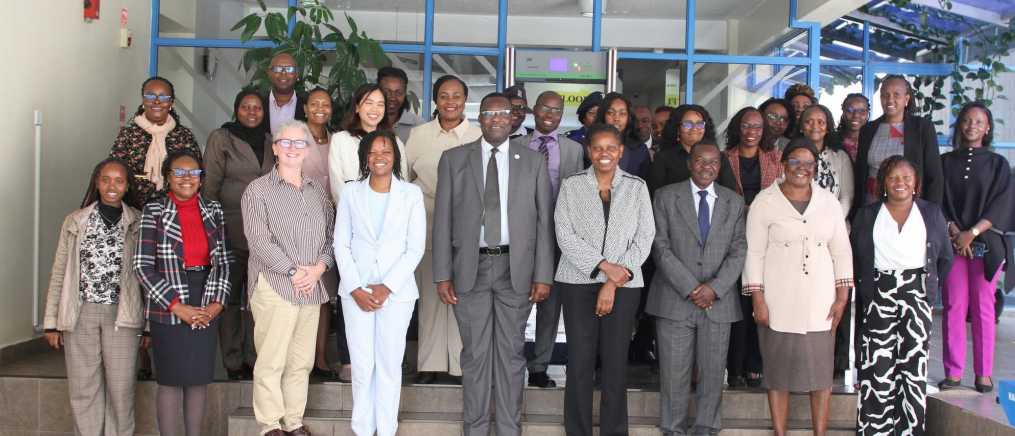
The Commission hosted the NGEC and IOM Partners’ Briefing Meeting in Nairobi on the gender equality and social inclusion component of the Regional Counter-Smuggling Programme, bringing the Commission together with the International Organization for Migration in Kenya on a protection-centred approach to counter-smuggling.
The programme runs across Kenya, Ethiopia and Somalia over three years, supported by the UK Home Office Border Security Command and implemented by IOM. It is directed at strengthening airport and border management systems, disrupting smuggling networks, improving inter-agency cooperation and enhancing protection for vulnerable migrants. In Kenya it supports operations at Jomo Kenyatta International, Moi International, Kisumu International, Eldoret International and Malindi airports.
The context is a region under sustained pressure. Conflict, economic hardship, climate shocks and limited livelihoods continue to shape migration and displacement across the Horn of Africa. IOM estimates that 1.7 million people, including migrants and members of host communities across Djibouti,Ethiopia, Kenya, Somalia, Tanzania and Yemen, will require assistance in 2026. Migrants on some routes face extortion, arbitrary detention, violence, exploitation and abuse.
Those risks are not distributed evenly. Gender, age and disability compound them. Women and girls face heightened exposure to sexual exploitation, gender-based violence and trafficking. Children require age-appropriate safeguarding. Persons with disabilities and other marginalised groups encounter additional barriers to information, assistance, reporting mechanisms and essential services.
This is the Commission’s central point. Equality and inclusion are part of migration governance, not a consideration added once the systems are already built. A system designed without them will process people it cannot see.
Commission Secretary and Chief Executive Officer Dr Purity Ngina joined Ms Nomagugu Ncube, Chief of Mission, IOM Kenya, and Vice Chairperson Thomas Koyier, EBS, in opening the discussions. The technical session on gender equality and social inclusion was led by Fiona Njeru. Director of Programmes and Research Paul Kuria guided discussion on a proposed Technical Working Group, which would provide a standing mechanism for coordination, technical guidance and shared responsibility across the component.
The briefing examined the programme’s objectives, scope, target institutions and expected results, and considered institutional coordination, technical capacity, information sharing, referral mechanisms and the integration of equality considerations into implementation.
The distinction the Commission is drawing is a practical one. Counter-smuggling work must be firm in disrupting criminal networks and protecting borders. A protection-sensitive system must at the same time be capable of identifying vulnerability, preventing exploitation, making referrals and ensuring that those who need assistance can obtain it without discrimination.
Kenya is a country of origin, transit and destination. A secure border protects territory. A just migration system also protects people. Kenya needs both.
.JPG)