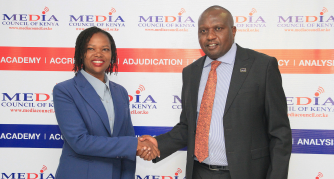
Nairobi, Kenya — In an era where information shapes perception, influence, and policy, the pen is proving as mighty as the gavel. Last week, the National Gender and Equality Commission (NGEC) paid a strategic courtesy call to the Media Council of Kenya (MCK), meeting with CEO David Omwoyo to chart a new course for journalism that drives social justice, amplifies marginalized voices, and advances gender equality across the nation.
The engagement comes at a time when Kenya’s media landscape is rapidly evolving, with stories spreading faster than ever across digital platforms and collaborative media spaces. For NGEC, whose mandate spans equality, equity, and inclusion across all sectors, this partnership presents an opportunity to ensure that public discourse reflects the lived experiences, contributions, and aspirations of Special Interest Groups—including women, youth, persons with disabilities, children, older members of society, minorities, and marginalized communities.
Central to the discussions was the Gender and Inclusivity Reporting category under the Annual Media Excellence Awards (AMEA), MCK’s flagship program that recognises outstanding journalism across the country.
Both NGEC and MCK committed to strengthening this category, not just as a recognition platform, but as a tool to mentor, train, and equip journalists to report ethically, inclusively, and with social impact. “Beyond the awards, we want this partnership to focus on mentorship and professional development. Our aim is not only to recognise excellence but also to strengthen capacity and support journalists in producing ethical, inclusive content on issues of national interest,” Mr Omwoyo said during the meeting.
NGEC Secretary Purity Ngina highlighted the Commission’s mandate to promote equality and inclusion across all sectors, noting that the media is a critical lever for social transformation. “Media houses dedicating space for gender stories is commendable. We are ready to provide expert input in identifying parameters for judging these stories,” Ms Ngina said, underscoring the importance of gender-responsive reporting and fair representation of marginalized groups. The meeting reinforced the understanding that journalism is not merely about information—it is a catalyst for accountability, inclusion, and societal change. By elevating stories that challenge inequality, the partnership aims to ensure that public discourse accurately reflects Kenya’s diverse population and addresses the structural biases that perpetuate marginalization.
MCK’s rigorous multi-stage evaluation process for the AMEA, now in its 14th year, was cited as a critical component in maintaining professionalism and ethics in media coverage. Both institutions emphasised the importance of clear guidance on framing gender and inclusion stories, noting that recognition of exemplary reporting incentivizes journalists to adopt practices that uphold human dignity and social equity.
A key pillar of the collaboration is professional development. Beyond recognising outstanding journalism, NGEC and MCK aim to mentor reporters, editors, and media houses to enhance the quality, accuracy, and impact of genderinclusive stories. This involves offering expertise in crafting narratives that not only inform but also inspire public action and policy reforms.
NGEC and MCK reaffirmed their commitment to deepening collaboration, ensuring that journalism in Kenya continues to serve as a force for equity, accountability, and inclusion. By recognizing and nurturing stories that centre marginalized communities, this partnership promises to shape a media landscape that reflects Kenya’s diverse realities, challenges inequality, and empowers citizens to participate fully in national conversations.
For journalists across the country, the partnership represents both a challenge and an opportunity: to produce content that not only informs but transforms, and to be recognized as architects of a society where equality and inclusion are not aspirational ideals but lived realities.