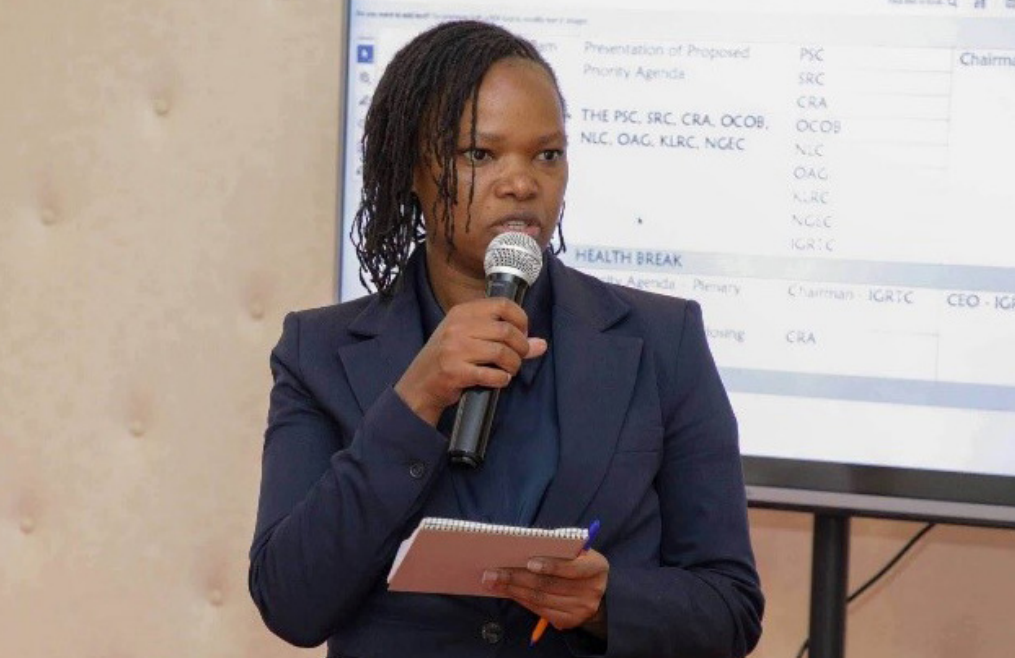
The Commission Secretary and Chief Executive Officer, Dr Purity Ngina, presented before a consultative meeting of Constitutional Commissions and Independent Offices convened in preparation for the 13th National and County Government Co-ordinating Summit.
The presentation placed gender equality, inclusion and the needs of Special Interest Groups at the centre of the national and devolved governance agenda, and set out what institutions should be able to demonstrate rather than assert.
The meeting brought together the Salaries and Remuneration Commission, the Commission on Revenue Allocation, the Public Service Commission, the Kenya Law Reform Commission, the Office of the Controller of Budget, the Office of the Auditor-General, the National Gender and Equality Commission and the Intergovernmental Budget and Economic Council.
Article 174 sets among the objects of devolution the protection and promotion of the interests and rights of minorities and marginalised communities, and the recognition of the right of communities to manage their own affairs. Article 27 requires equal treatment and freedom from discrimination. Section 8 (b) of the National Gender and Equality Commission Act, 2011 requires the Commission to monitor, facilitate and advise on the integration of the principles of equality and freedom from discrimination in all national and county policies, laws and administrative regulations.
Read together, those provisions establish a standard that a county or a national programme can be measured against. Equitable development is not established by the volume of expenditure or the number of projects commissioned.
It is established by evidence of who obtained the service, who was employed, who was consulted, and who was left out of both the plan and the record. That evidence requires coordination. Allocation, remuneration, appointment, budget execution and audit sit with different institutions, and a gap in any one of them is where an inclusion commitment quietly lapses.
The Commission will continue to advocate for inclusive governance and for institutional partnerships that advance equality, strengthen accountability and deliver equitable development at both levels of government
.JPG)