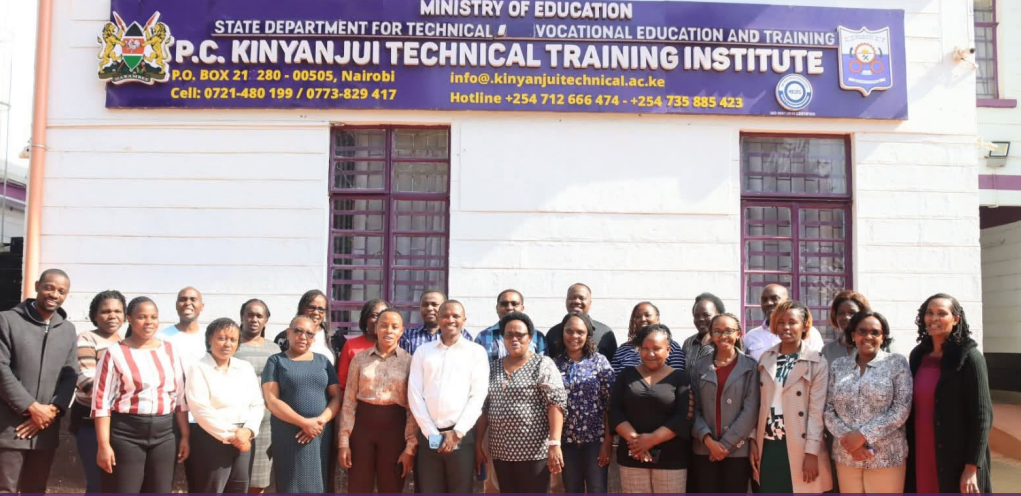
The Commission held a capacity-building session on gender and inclusivity with the senior management of P.C. Kinyanjui Technical Training Institute, bringing institutional leadership into a working conversation about the barriers to equal participation inside their own institution.
The session covered gender concepts and perspectives, gender mainstreaming, gender-based violence, unconscious bias, workplace gender policies and compliance, diversity, equity and inclusion, disability inclusion, and inclusive recruitment, retention and career development.
The choice of audience is the substance of the story. Exclusion in technical and vocational education is rarely the product of a written rule. It is produced by admission decisions, by which workshops are physically reachable, by whether a harassment complaint is heard or absorbed, by how a timetable treats a student with caring responsibilities, and by who is encouraged to continue after a difficult first term. Every one of those is a management decision, and management decisions are made by the people who were in that room.
The Commission’s Model Gender Mainstreaming Policy for the technical and vocational education and training sector identifies the barriers: gender stereotypes, discrimination, financial constraints, unfriendly training environments, information gaps and limited prospects for decent work. It calls for stronger institutional capacity to address them, which is a different requirement from awareness.
The engagement was therefore aimed past sensitisation, at the capacity of institutional leaders to mainstream gender and inclusion in policy, programmes, workplace practice and decision-making, and to build environments in which women, men, persons with disabilities and other Special Interest Groups can participate and benefit on equal terms.
Inclusive skills development is not a question of access to training alone. It is a question of whether every learner and member of staff has a fair opportunity to participate, progress and reach their potential. Where leadership understands inclusion, an institution is in a position to make equality part of ordinary practice rather than an annual event.
Every one of those is a management decision, and management decisions are made by the people who were in that room.
.JPG)