Summary
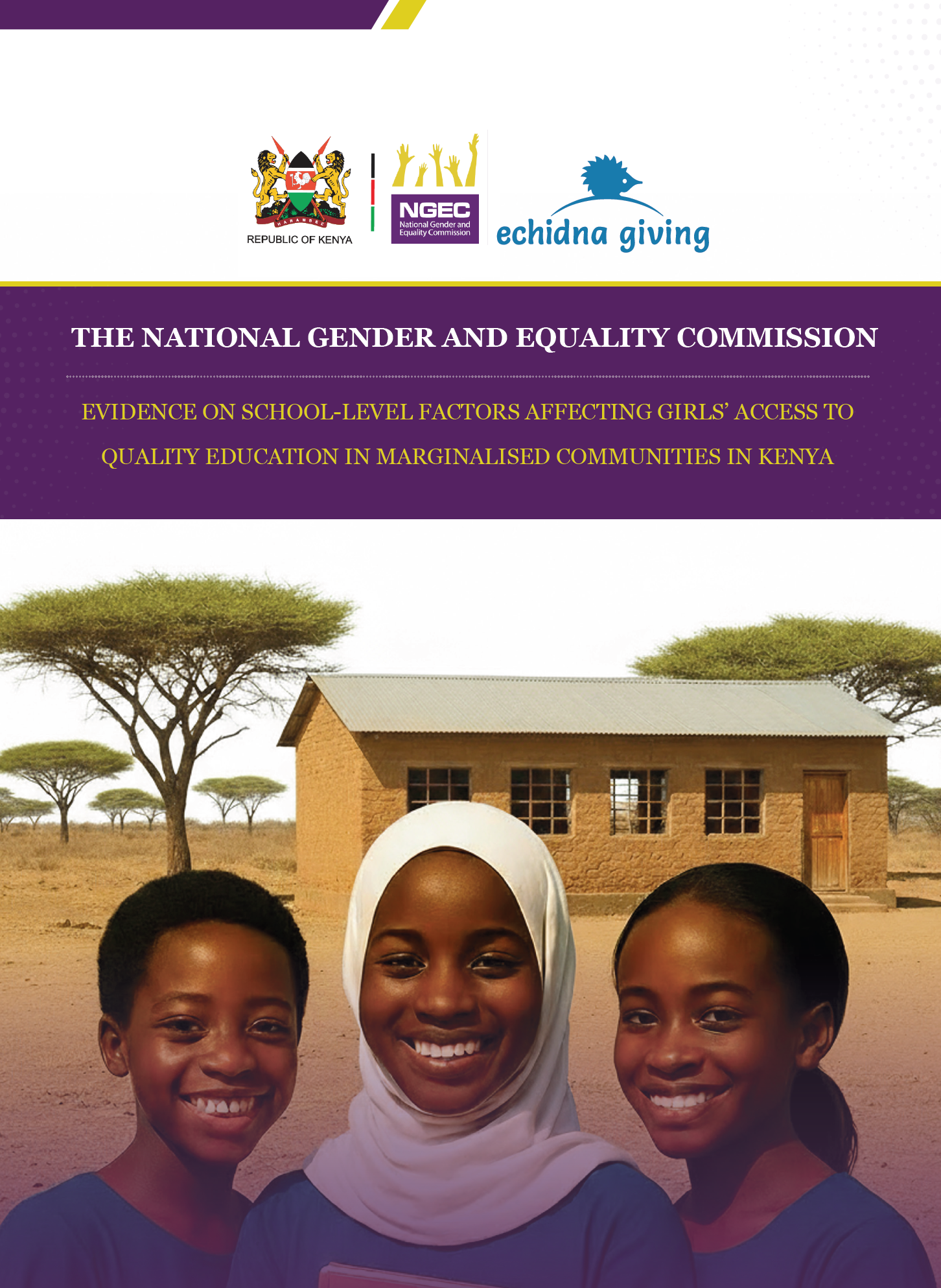
The National Gender and Equality Commission (NGEC) surveyed public primary schools in 19 counties, covering arid and semi-arid lands (ASALs) and Nairobi's informal settlements, in the first week of September 2025. Girls were 48% of enrolled learners and boys 52%, with an overall Gender Parity Index of 0.91 across grades. Among headteachers, 76% were male and 24% female.
Sanitation and inclusion gaps were widespread. The average pupil-toilet ratio was 43:1 for boys and 32:1 for girls, above the national standards of 25:1 and 20:1. Only 26% of schools had toilets accessible to girls with disabilities. Counties with more than 40 girls per toilet recorded menstruation-related absenteeism of 15.8%, against 7.3% where sanitation was adequate. Teenage pregnancy was reported in 30% of schools, and 74% of schools knew the School Re-entry Guidelines.
The report names Mandera, Wajir and Garissa as needing urgent action, and cites Nairobi City, Tharaka-Nithi and Makueni as good practice. Findings are not nationally representative.
Key findings
- In the surveyed schools, 76% of headteachers were male and 24% female; headship was entirely male in Wajir and Mandera, while 89% of headteachers in Nairobi's informal settlements were female.
- Boys made up 52% and girls 48% of enrolled learners, giving an overall Gender Parity Index of 0.93 by county and 0.91 by grade; Mandera had the lowest county GPI at 0.63.
- On average 53.4% of boys and 46.6% of girls transitioned to junior school (Grade 7), with a transition GPI of 0.9; Mandera, Turkana and Garissa each recorded 0.6.
- The average pupil-toilet ratio was 43:1 for boys and 32:1 for girls, above the national standards of 25:1 and 20:1; Mandera had 97:1 for boys.
- Menstruation-related absenteeism was 15.8% in counties with inadequate sanitation (over 40 girls per toilet), compared with 7.3% in counties meeting the standard.
- On average 26% of schools had toilets accessible to girls with disabilities and 13% had toilets accessible to staff with disabilities; learners with disabilities were under 1% of enrolment.
- On average 37% of schools reported teenage pregnancies, 21.4% of girls were re-admitted, and 13% of schools reported child marriage cases; 74.4% of schools were aware of the re-entry guidelines.
- The most cited Competency-Based Education challenge was inadequate teachers (61.9% of schools), followed by inadequate learning resources (60.5%) and government funding (54.7%).
Recommendations
- Provide gender-responsive leadership training for school Board of Management and Parents-Teachers Association members and enforce gender-representation quotas in school governance.
- Operationalise the School Re-entry Guidelines through county-level enforcement and NGEC compliance audits, and set up flexible learning pathways for pregnant and parenting learners.
- Expand school-feeding, bursary and transport programmes in vulnerable counties to reduce economic and distance barriers.
- Prioritise gender-inclusive, disability-friendly sanitation in school grants and supply menstrual-health products and education through Ministry of Education and Ministry of Health coordination.
- Scale up comprehensive sexual and reproductive health education using trained Life Skills teachers and local health officers.
- Strengthen child-protection committees and coordinate education, social protection and justice sectors to enforce sanctions on FGM, child marriage and child labour.
- Institutionalise gender- and disability-disaggregated data in the Education Management Information System (EMIS) for annual NGEC tracking.
- Expand digital-learning infrastructure and teacher capacity in marginalised schools and integrate climate-adaptation education into curricula.
How the study was done
A cross-sectional descriptive study using stratified sampling of public primary schools in ASAL counties and Nairobi informal settlements, selected by probability proportional to size from Ministry of Education registries. Data were collected in the first week of September 2025 in 19 counties using an electronic structured tool, supplemented by key informant interviews and focus group discussions with school leaders and county education, security and administration officials. Analysis used descriptive statistics, chi-square tests, t-tests and regression, with thematic analysis of qualitative data. Findings are not nationally representative.
Questions & answers
What does the NGEC 2025 report on girls' education in marginalised communities find?
The survey of public primary schools in 19 counties found girls were 48% of enrolled learners and boys 52%. It also found male-dominated school leadership (76% male headteachers), inadequate sanitation, low disability inclusion, teenage pregnancy in about 30% of schools, and lower girls' transition to junior school in Mandera, Garissa and Turkana.
Which Kenyan counties were covered by the study?
The study covered 19 counties: Kwale, Kilifi, Tana River, Garissa, Wajir, Mandera, Isiolo, Meru, Tharaka-Nithi, Kitui, Makueni, Turkana, West Pokot, Samburu, Baringo, Laikipia, Narok, Kajiado and Nairobi City. The Nairobi schools surveyed were all in informal settlements. The findings are not nationally representative.
How does poor sanitation affect girls' school attendance in Kenya?
The report links sanitation to attendance. In counties with more than 40 girls per toilet, an average of 15.8% of girls missed school due to menstruation, versus 7.3% in counties meeting the 40:1 standard. Overall, menstruation-related absenteeism averaged 10.9%, and the girls' pupil-toilet ratio averaged 32:1 against a standard of 20:1.
How many girls transition to junior school compared with boys in the surveyed counties?
On average, 53.4% of boys and 46.6% of girls transitioned to Grade 7, a transition Gender Parity Index of 0.9. The lowest GPIs were 0.6 in Mandera, Turkana and Garissa. Girls' transition slightly exceeded boys' in Tana River and Nairobi City.
How common are teenage pregnancy and re-entry to school in the surveyed schools?
Teenage pregnancy was reported in 37% of schools in the county table, which the report describes as about 3 in 10 schools. The average re-admission rate for girls after pregnancy was 21.4%. About 74% of schools knew the national School Re-entry Guidelines, but only 21.7% allowed time for baby care.
What are the main challenges in implementing Competency-Based Education in these schools?
Inadequate teachers to handle new learning areas was reported by 61.9% of schools, inadequate learning resources by 60.5%, inadequate government funding by 54.7%, inadequate infrastructure by 42.5%, and difficulty accessing the assessment portal by 37.0%. The report says structural barriers outweigh pedagogical ones.
Which counties does the report highlight as needing urgent action and as good practice?
The report names Mandera, Wajir and Garissa as needing urgent focused action because of gender disparities in enrolment and leadership, staffing gaps and weak WASH facilities. It cites Nairobi City's informal settlements, Tharaka-Nithi and Makueni as best practice examples for female leadership, teacher training and pupil-teacher ratios.
What does the report recommend to improve girls' access to quality education?
Recommendations include gender-responsive leadership training and quotas in school governance, enforcing the re-entry guidelines, expanding school feeding, bursaries and transport, disability-friendly sanitation, menstrual-health supplies, stronger sexual and reproductive health education, child-protection enforcement, and disaggregated data in EMIS.
