Summary
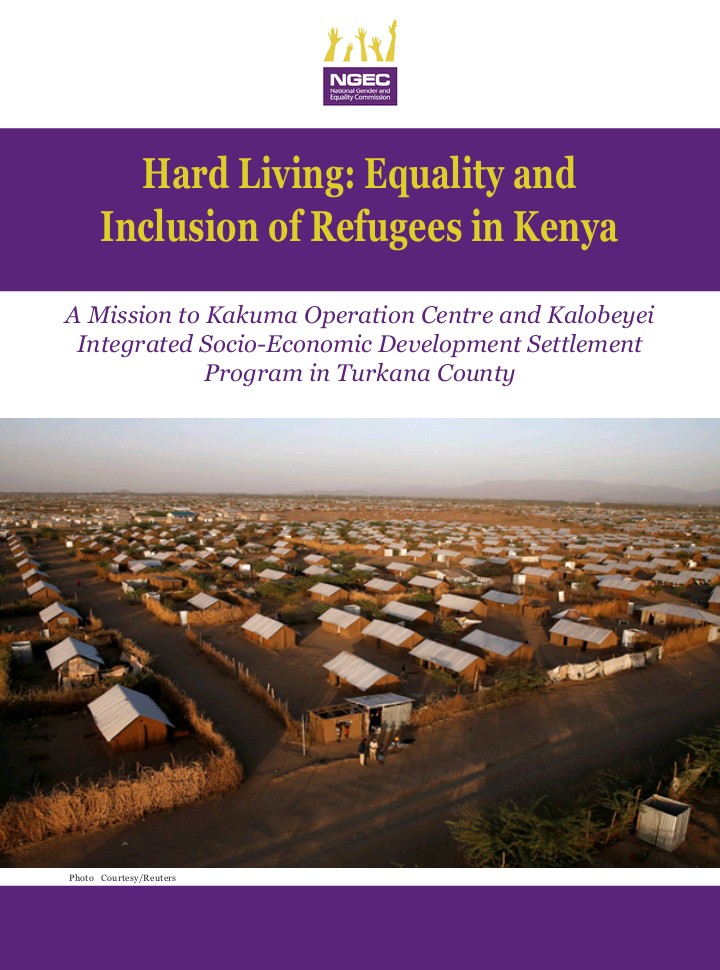
The National Gender and Equality Commission (NGEC), with UNHCR and UNFPA, visited the Kakuma refugee camp and the Kalobeyei Integrated Socio-Economic Development Settlement Program in Turkana County. The mission followed a 25 July 2019 UNHCR invitation. It met refugees, host community members, police, the judiciary, and national and county government officials. By the end of August 2019, Kakuma and Kalobeyei held 191,500 registered refugees and asylum-seekers.
The mission found strong practices, including the Kenya Red Cross GBV one-stop centre, the Morneau Sharple girls' boarding school and ICT tools such as KASI, AIM and KEMIS. It also found gaps. Kakuma Sub-county had only three female officers among 160 police officers, no dedicated SGBV desk, and survivors were charged for P3 or Post Rape Care forms. Refugee persons with disabilities reported harassment at food distribution and barriers in schools. Host community members said NGOs favoured refugees.
The report ends with recommendations for Parliament, ministries, Turkana County Government, UNHCR, UNFPA, NCPWD and NGEC, and lists NGEC's own follow-up commitments.
Key findings
- Kakuma Sub-county had only three female police officers out of 160, and Kakuma Police Station had no office or desk dedicated to SGBV cases.
- Survivors of sexual and gender-based violence were charged for P3 or Post Rape Care forms because the service was only available in private health facilities, and police sometimes paid the costs.
- Kakuma camp and Kalobeyei settlement had 191,500 registered refugees and asylum-seekers by the end of August 2019, and the refugees came from about 19 nationalities according to the Deputy County Commissioner.
- In Turkana West, there were 18 ECDE centres in refugee settlements compared with 100 in the host community, and 26 primary schools in settlements compared with 59 in the host community.
- Only one of the seven secondary schools in the refugee settlements was a girls' boarding school; Morneau Sharple School had 347 girls enrolled as of October 2019 and produced the best results in Turkana West Sub-county in the 2018 KCSE.
- Refugee persons with disabilities reported harassment by police or security officers during food distribution, punishment of children with disabilities for arriving late, and bullying in schools.
- Host community stakeholders said most NGOs directed resources to refugees, leaving locals facing food shortage, unemployment and insecurity, which led to frequent conflicts with refugees.
- About 98.7 per cent of adult refugees in Kakuma had mobile phones, and UNHCR reported that its AIM system cut resettlement processing time from 6 months to 1 month.
Recommendations
- Parliament should pass the Refugee Bill 2019 to guide integration of host communities and refugees, and ensure it addresses civil registration of births and deaths.
- The Ministry of Interior and Coordination of National Government should add GBV training to the National Police Service curriculum, set up gender desks in all police stations, and establish a remand home for children in Turkana County.
- The Ministry of Labour and Social Protection, with the Interior Ministry, should operationalize the Child Protection Centre at Kakuma Police Station.
- The Ministry of Education and the Teachers Service Commission should ensure all teachers are TSC-licensed, post more teachers to Turkana, and expand inclusive education and barrier-free school environments.
- The Ministry of Education should replicate the Morneau Sharple School protection model in other areas with a similar profile and in Kalobeyei.
- Turkana County Government should form SGBV committees, establish a gender recovery centre in Lodwar level 4 and 5 hospitals, and help youth, PWDs and women access government procurement opportunities.
- UNHCR should promote SGBV case management and referral, support integration of refugee and host community economies, schools and health facilities, and create barrier-free offices for PWDs.
- NGEC should strengthen the Equality and Inclusion Technical Working Group, advise against charging for P3 or PRC forms, support the Turkana County Gender Mainstreaming Policy, and comment on the Refugee Bill 2019.
How the study was done
This is a mission report, not a survey. NGEC leadership and senior secretariat staff, with UNHCR and UNFPA officers, held a three-day field mission in Kakuma and Kalobeyei. It combined site visits, meetings and a multi-sectoral conference with refugees, the host community, police, the judiciary, UN agencies, NGOs and national and county officials. The report records their submissions and agreed actions.
Questions & answers
What did the NGEC mission to Kakuma and Kalobeyei find?
NGEC found strong practices such as the Kenya Red Cross GBV one-stop centre, the Morneau Sharple girls' school and ICT systems. It also found gaps: few female police officers, charges for P3 forms, barriers for persons with disabilities, unequal education facilities, and host community complaints that NGOs favoured refugees.
How many refugees live in Kakuma and Kalobeyei?
By the end of August 2019, Kakuma Camp and Kalobeyei Integrated Settlement had 191,500 registered refugees and asylum-seekers. The Deputy County Commissioner said they came from about 19 different nationalities. Kakuma Camp was established in 1992, and Kalobeyei was identified, 20km from Kakuma town, after the 2014 influx exceeded camp capacity by over 58,000 people.
How well is Kakuma Police Station equipped to handle gender-based violence?
The report found it poorly equipped. Kakuma Sub-county had three female officers among 160 officers, no dedicated SGBV office, and used a sea container as a cell with three chambers. Officers trained on SGBV were transferred, and survivors were charged for P3 or Post Rape Care forms.
What challenges do refugees with disabilities face in Kakuma?
Refugee persons with disabilities said police or security officers harassed them during food distribution and asked for a separate queue. They said children with disabilities were punished for arriving late, were bullied, and faced inaccessible terrain. They also reported limited access to specialized health services and requested business licence fee waivers.
What is the Morneau Sharple School in Kakuma?
It is a girls' boarding school in Kakuma, in existence since 2013, set up as a protection and learning centre. As of October 2019 it had 347 girls and allocated 10% of places to the host community. It produced the best 2018 KCSE results in Turkana West Sub-county, and 1,690 girls had graduated.
What are the host community's concerns about refugee programmes in Turkana?
Host community stakeholders said most NGOs channelled resources to refugees, leaving locals facing poverty, food shortage, insufficient services and unemployment. They said this caused frequent conflicts. They recommended equitable access to resources and services, and that UNHCR involve the host community in its corporate social responsibility initiatives.
What did NGEC commit to doing after the mission?
NGEC committed to follow up with the Interior Ministry on birth and death registration, with NCPWD on early disability detection, and with the State Department of Social Protection on the Kakuma Police Children Protection Center. It also pledged an advisory against charging for P3 or PRC forms and technical support for Turkana's gender policy.
