Summary
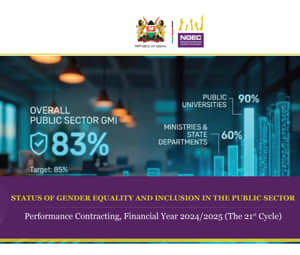
Kenya's public sector scored 83% overall on Gender Mainstreaming and Inclusion (GMI) in the 21st Cycle of Performance Contracting, Financial Year 2024/2025, against a target of 85%. Public universities scored highest at 90% and ministries and state departments lowest at 60%. Only 88 Ministries, Departments and Agencies (MDAs) submitted reports, compared with 201 in 2023/2024 and 390 in 2022/2023.
The evaluated institutions allocated about KES 54.6 billion, or 9.7% of their total budget, to GMI, almost all of it from state corporations. Women made up 39.93% of the 93,506 staff evaluated. Persons with disabilities were 2.0% of staff, below the 5% requirement, and 88% of institutions met the not more than two-thirds gender principle.
The report notes a downward trend in GMI performance between 2022/23 and 2024/25, with the largest drop among ministries and state departments. Agencies cited limited capacity, low budgets and entrenched gender stereotypes as challenges. The report recommends routine reporting, renewed capacity building, adherence to gender responsive budgeting guidelines and physical verification of reports.
Key findings
- The overall public sector score on Gender Mainstreaming and Inclusion was 83% in FY 2024/2025 against a target of 85%: public universities scored 90%, tertiary institutions 84%, state corporations 82% and ministries and state departments 60%.
- Only 88 Ministries, Departments and Agencies submitted progress reports for FY 2024/2025, down from 201 in 2023/2024 and 390 in 2022/2023.
- The evaluated public sector institutions allocated approximately KES 54.6 billion, or 9.7% of their total annual budget, to gender mainstreaming and inclusion; state corporations allocated 11.15% while ministries and state departments allocated 0.02% and public universities 0.04%.
- Women were 39.93% (37,339) of the 93,506 public sector staff evaluated; women outnumbered men only in tertiary institutions, at 52.90%.
- Persons with disabilities made up 2.0% (1,828) of the public sector workforce, below the 5% employment requirement, and 34.9% of them were women; tertiary institutions had the lowest share at 0.9%.
- Eighty-eight percent of public sector institutions complied with the not more than two-thirds gender principle, and all ministries, state departments and public universities complied.
- Minority and marginalized communities were 6.3% of the public sector workforce and youth were 18.1%; ministries had the lowest minority representation at 0.2% and public universities the lowest youth share at 5.9%.
- Ninety-seven percent of institutions had a gender policy and 97% had a GBV policy, but only 33% of ministries and state departments had a gender policy, and 33% of those with a GBV policy had not implemented it.
Recommendations
- The state should establish a mechanism ensuring routine reporting by the public sector on compliance with the minimum gender mainstreaming and inclusion indicators.
- Continuous capacity building of public sector institutions on gender equality and inclusion should resume.
- Public agencies should adhere to the national and county gender responsive budgeting guidelines and related budget circulars when planning and budgeting.
- An incentive and sanction scheme should be introduced to support adherence to gender responsive budgeting guidelines.
- Oversight agencies should conduct physical verifications of reports made by state agencies to assess the correctness, completeness and accuracy of the data.
How the study was done
The report summarises results from the 21st Cycle of Public Sector Performance Contracting for FY 2024/2025. NGEC, with the State Department for Gender and Affirmative Action, developed a standardized reporting template and minimum set of GMI indicators. A total of 88 Ministries, Departments and Agencies submitted progress reports, which were evaluated on selected indicators and compared with 2022/23 and 2023/24 results.
Questions & answers
What was the overall gender mainstreaming and inclusion score of Kenya's public sector in 2024/2025?
The overall public sector performance on Gender Mainstreaming and Inclusion was 83% in the 21st Cycle of Performance Contracting for FY 2024/2025, below the 85% target. Public universities scored highest at 90%, while ministries and state departments scored lowest at 60%. State corporations scored 82% and tertiary institutions 84%.
How much did Kenyan public institutions budget for gender mainstreaming?
The 88 evaluated public sector institutions allocated approximately KES 54.6 billion, equal to 9.7% of the total budget they received for FY 2024/2025. Nearly all of it came from state corporations, which allocated 11.15% of their budgets. Ministries and state departments allocated only 0.02%, and public universities 0.04%.
What percentage of the public sector workforce in Kenya are women?
Women were 39.93% of the 93,506 public sector staff evaluated in FY 2024/2025, or 37,339 women. Women were fewer than men in most sectors, but made up 52.90% of staff in tertiary institutions. In ministries and state departments, women were 48.04%, in public universities 43.73% and in state corporations 37.21%.
Is the public sector meeting the 5% employment target for persons with disabilities?
No. Persons with disabilities were 2.0% of the public sector workforce, or 1,828 of 93,506 staff, against a requirement of at least 5%. Ministries and state departments had the highest share at 2.6%, followed by public universities at 2.5%. Tertiary institutions had the lowest at 0.9%. About 34.9% of employees with disabilities were women.
How many public institutions comply with the two-thirds gender principle?
Eighty-eight percent of public sector institutions complied with the principle that not more than two-thirds of the workforce be of the same gender in FY 2024/2025. All ministries, state departments and public universities complied. Compliance was 82% in state corporations and 88% in tertiary institutions.
What challenges did public institutions report in implementing gender mainstreaming?
Agencies reported declining reporting on GMI indicators, attributed mainly to the lack of a policy framework obliging agencies to act. They also cited inadequate institutional capacity, inadequate budgets (some sectors allocating as little as 0.02%), and entrenched gender stereotypes and negative gender norms affecting career choices, recruitment, training and promotion.
What does the NGEC report recommend for improving gender equality in the public sector?
The report recommends that the state establish a mechanism for routine reporting on the minimum GMI indicators, that capacity building of public institutions resume, and that agencies follow national and county gender responsive budgeting guidelines, backed by incentives and sanctions. It also recommends that oversight agencies physically verify the data reported by state agencies.
