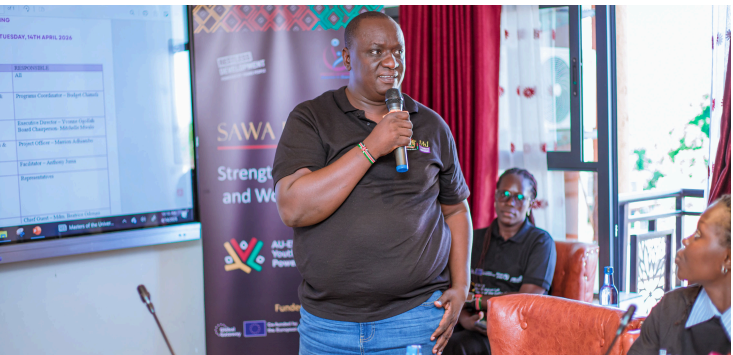
The National Gender and Equality Commission (NGEC) Kisumu Regional Office has participated in the inception meeting of the Strengthening Action and Women Agency (SAWA) Project in Kisumu County, an initiative aimed at empowering young women and expanding their participation in governance, civic engagement, and public policy processes. The project is being implemented by Dreams Redefined CBO with support from the AU–EU Youth Voices Lab and in partnership with Restless Development, focusing on mentorship, leadership development, and structured pathways for young women to influence decision-making.
The SAWA Project is designed to strengthen the agency of young women by addressing longstanding barriers that limit their participation in leadership and governance systems. These barriers include restricted access to mentorship opportunities, economic constraints, harmful gender stereotypes, unpaid care responsibilities, and exclusion from formal policy and decision-making spaces.
The initiative seeks to respond to these challenges through structured mentorship, leadership training, and sustained capacity building aimed at enhancing confidence, networks, and civic engagement skills among participants. The programme aligns with broader regional and continental efforts supported under the AU–EU Youth Voices Lab, which promotes youth engagement in governance and accountability processes across participating countries.
The inception meeting was described as a cocreation session that brought together stakeholders to design a practical roadmap for implementation, partnership development, and long-term sustainability.
Participants engaged in discussions on programme structure, delivery mechanisms, and strategies for ensuring that outcomes remain locally relevant and community-driven.
The approach reflects a broader shift in youth programming that emphasises participation of beneficiaries in designing interventions that directly affect them, particularly in governance and leadership development initiatives.
A central component of the SAWA Project is a structured mentorship programme that will directly support 60 young women through 30 mentors.
The mentorship framework is intended to provide participants with leadership skills, confidence building, networking opportunities, and practical tools for engagement in decision-making spaces.
Stakeholders noted that mentorship remains a critical intervention in addressing the leadership gap affecting young women, particularly in contexts where access to role models and institutional support remains limited.
The programme is also expected to strengthen peer learning and intergenerational knowledge transfer between mentors and mentees.
The SAWA initiative is implemented under the AU–EU Youth Voices Lab framework, a multi-country programme focused on strengthening youth participation in governance, advocacy, and policy engagement.
The initiative places emphasis on empowering young people to influence decision-making processes and improve accountability within institutions through structured engagement platforms and capacity development support.
The National Gender and Equality Commission continues to support initiatives that promote equality, inclusion, and non-discrimination, particularly among special interest groups including women, youth, persons with disabilities, and marginalised communities.
Through its participation in the SAWA Project inception meeting, the Commission reaffirmed its commitment to strengthening institutional frameworks that support women’s participation in governance and public policy processes.
The Commission’s engagement reflects its broader mandate to ensure that equality principles are integrated into development programmes and institutional practices at county and national levels.
The launch of the Strengthening Action and Women Agency (SAWA) Project in Kisumu County marks a targeted effort to address persistent barriers to young women’s participation in governance and civic life.
Through structured mentorship, capacity building, and collaborative implementation supported by regional partners, the initiative seeks to strengthen leadership pathways and civic engagement opportunities.
As implementation progresses, emphasis will remain on ensuring that young women are not only participants in governance processes but also active contributors to decision-making systems at community and county levels.