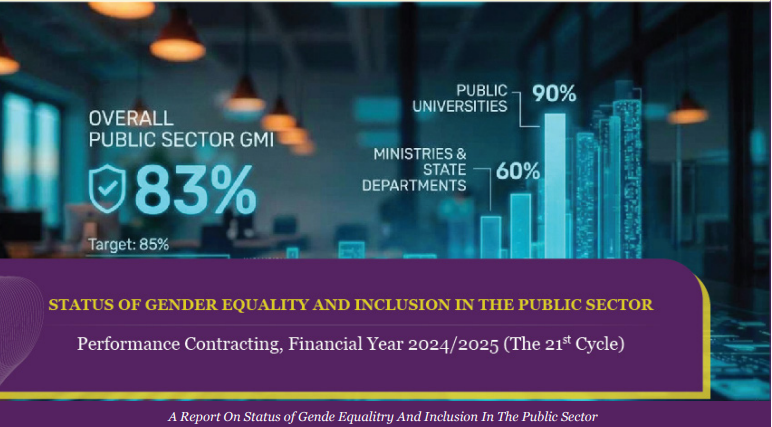
In practice, reporting under the Performance Contracting process remains largely dependent on institutional initiative. There is another contradiction in the findings. Policies are widely available, but implementation is less consistent. Ninety-seven per cent of reporting institutions have a gender policy, while the same proportion have a policy addressing gender-based violence. All reporting public universities have both.
Yet having a policy does not necessarily mean acting on it. Among institutions with a gender policy, 86 per cent reported implementing it. For gender-based violence policies, the implementation rate was 88 per cent. Ninety-four per cent of institutions reported including gender mainstreaming activities in their annual work plans, while 82 per cent had allocated a budget for gender mainstreaming and GBV prevention and response.
Even the reported budget figures require careful interpretation. The 88 institutions reported allocating KSh 54.55 billion to gender mainstreaming and inclusion, equivalent to 9.7 per cent of their combined annual budgets of KSh 562.23 billion. But almost all of that money, KSh 54.50 billion, came from state corporations. They allocated 11.15 per cent of their budgets to these activities. Public universities allocated 0.04 per cent, tertiary institutions 0.41 per cent, while the three reporting ministries and state departments allocated only 0.02 per cent between them.
The headline figure of KSh 54.55 billion therefore should not be read a as an average public sector commitment. It is overwhelmingly driven by one category of institutions. The institutions themselves identified four major obstacles to progress. First is capacity. Agencies repeatedly called for structured training for gender mainstreaming and inclusion committees. Second is funding. Some institutions reported allocations as low as 0.02 per cent of their annual expenditure. Third are persistent gender stereotypes, which institutions said continue to influence career choices, recruitment, training and promotion. Fourth is the declining rate of reporting itself.
The Commission’s recommendations are therefore directed as much at the system as they are at individual institutions. Under Section 8(j) of the National Gender and Equality Commission Act, Cap 7K, NGEC receives and evaluates annual reports from public institutions on compliance with constitutional principles of equality and freedom from discrimination.
The Commission is calling for a mechanism for routine public sector reporting against minimum indicators of gender mainstreaming and inclusion. It is also recommending continuous capacity building, greater application of national and county gender-responsive budgeting guidelines and relevant Treasury circulars, supported by incentives and sanctions.
It further recommends physical verification of reports submitted by ministries, counties, departments and agencies to establish whether the information provided is complete, accurate and supported by evidence. The most important number in this cycle may therefore be the one that appears first: two per cent. It tells us that among the institutions that reported, only two out of every 100 employees are persons with disabilities. But it also raises a more difficult question. Is two per cent the true picture of disability representation in Kenya’s public service, or simply the picture we can see? At present, the country cannot answer that question with confidence because too many institutions are not reporting. That is the real inclusion gap: not only who is missing from the public service, but who is missing from the data that should tell us who is missing.