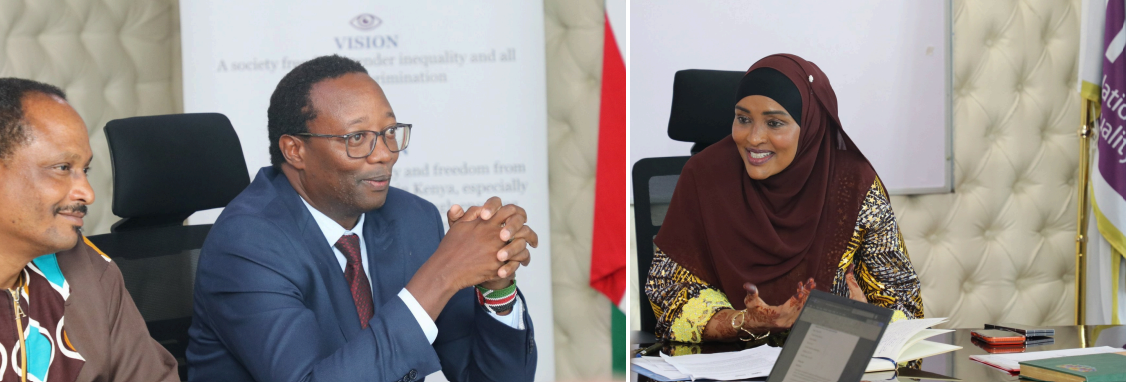
Questions of land, identity and historical justice took centre stage during a consultative meeting between the National Gender and Equality Commission (NGEC) and representatives of the Ogiek Peoples Development Program (OPDP). The engagement provided a platform for the Ogiek community to present long-standing grievances linked to displacement from the Mau Forest Complex, including eviction, marginalisation, loss of livelihood and concerns over recognition as an indigenous group. The discussions also explored possible pathways toward strengthened accountability, inclusion and protection of their rights.
The Ogiek community, widely regarded as one of Kenya’s last remaining forestdwelling indigenous groups, traditionally inhabits the Mau Forest Complex. During the meeting, representatives raised concerns over continued challenges in being formally recognised as a distinct indigenous community. They noted that limited recognition has contributed to exclusion from key decision-making processes and development interventions affecting their ancestral territories and cultural identity.
Community representatives detailed grievances relating to repeated evictions and displacement from forest land they consider ancestral. They stated that these actions have disrupted long-standing cultural ties to the land and altered traditional settlement patterns. Participants also raised concerns that land previously occupied by the community has, in some instances, been allocated to third parties following evictions, further complicating land tenure issues. The discussions highlighted the impact of displacement on the community’s traditional livelihood systems. The Ogiek, whose way of life has historically been closely linked to forest ecosystems through hunting and gathering, noted that restricted access to forest resources has significantly undermined their economic survival systems. Stakeholders observed that these disruptions have contributed to increased socio-economic vulnerability within the community.
Participants further raised concerns regarding continued marginalisation and limited participation in governance and development processes affecting their ancestral lands. Community representatives noted that exclusion from planning and decision-making structures has contributed to unresolved grievances over time. The engagement underscored the need for more inclusive processes that ensure indigenous voices are reflected in policy and development decisions.
NGEC Chairperson Hon. Rehema Jaldesa reaffirmed the Commission’s commitment to addressing structural inequalities affecting indigenous communities, emphasizing the importance of dignity, justice and recognition.
“No community should be erased from its land or identity. The Ogiek community’s concerns speak to deeper questions of justice, inclusion and historical redress that must be addressed with urgency and fairness,” she said.
She further underscored the need for sustained institutional engagement.
“We must move beyond acknowledgement to action. Protecting the rights of indigenous communities requires coordinated efforts, accountability and respect for their lived realities,” Hon. Jaldesa added. The meeting also explored recommendations aimed at addressing the grievances raised, including strengthening accountability mechanisms, improving institutional coordination and enhancing engagement with relevant stakeholders. Participants emphasised the importance of continued dialogue in resolving historical and structural injustices affecting the community.
The Commission reaffirmed its commitment to promoting and protecting the rights of indigenous and marginalised communities, including the Ogiek. The Commission noted that addressing structural inequality requires sustained collaboration between state institutions, partners and community actors.
The consultative engagement between NGEC and OPDP highlighted long-standing concerns relating to displacement, identity recognition, livelihood disruption and marginalisation of the Ogiek community. Stakeholders agreed on the need for continued engagement and coordinated action to address these grievances.