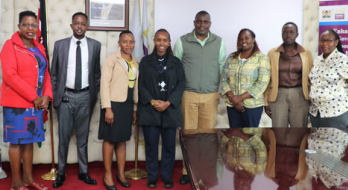
Efforts to advance the rights and wellbeing of persons with disabilities increasingly depend on strong collaboration between institutions and community-based organizations. Recognizing this, the National Gender and Equality Commission hosted a delegation from L'Arche Kenya for a courtesy call aimed at deepening cooperation on disability inclusion and social protection.
The meeting created an opportunity for both institutions to explore areas of collaboration in advancing community awareness, inclusive education and reforms in care systems affecting persons with disabilities.
At the centre of the discussions was a shared commitment to ensuring that disability rights are not treated as a peripheral issue but as an integral component of Kenya’s broader equality and human rights agenda.
Participants emphasized the importance of community education in addressing stigma and discrimination faced by persons with disabilities.
Despite progressive constitutional protections, many families and communities still lack adequate awareness of disability rights and available support mechanisms. Misconceptions, cultural stigma and social exclusion continue to limit access to education, healthcare and employment opportunities for many persons with disabilities.
Through joint initiatives, the Commission and L’Arche Kenya aim to expand awareness campaigns that empower communities with knowledge on disability inclusion, human rights protections and available institutional support.
Another key area of discussion centered on inclusive education, an issue that remains central to Kenya’s development agenda.
Access to education for learners with disabilities has improved in recent years, yet many institutions still face challenges related to accessibility, specialized learning support and inclusive infrastructure.
Collaboration between the Commission and L’Arche Kenya could help strengthen advocacy for inclusive education policies while supporting institutions to adopt practices that ensure students with disabilities learn in safe, supportive and accessible environments.
Ensuring that learners with disabilities remain visible within education systems, participants noted, is essential for building a more equitable society.
Safeguarding mechanisms to protect persons with disabilities from abuse, neglect and exploitation were highlighted as a critical component of these reforms. Both institutions expressed interest in working together to strengthen advocacy, policy dialogue and community engagement aimed at ensuring that care systems align with human rights principles and constitutional protections.
Resource mobilisation also featured prominently in the discussions, with both organisations recognising that sustainable programmes require strong partnerships and coordinated investment. By pooling expertise and strengthening networks across government institutions, civil society and development partners, initiatives aimed at empowering persons with disabilities can achieve broader reach and lasting impact.
Such partnerships also create opportunities for scaling programmes that promote social inclusion, economic participation and community-based support systems for persons with disabilities.