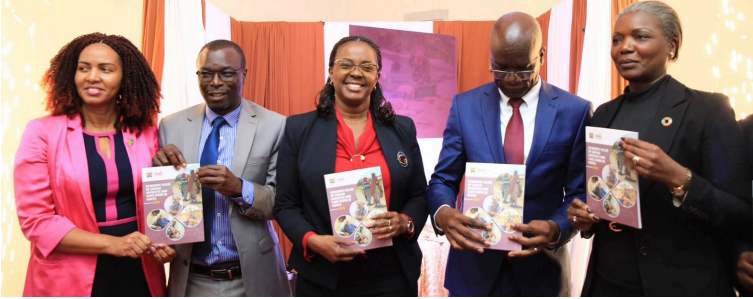
The National Gender and Equality Commission (NGEC) participated in the launch of the “Economic Value of Unpaid Domestic and Care Work in Kenya 2025”, a landmark report developed jointly by the Kenya National Bureau of Statistics (KNBS), the Ministry of Gender and Affirmative Action, UN Women, and Sweden Sverige.
The report reveals that women in Kenya spend 25.8 billion hours annually on unpaid domestic and care work, equivalent to 23.1% of Kenya’s GDP. These invisible hours — dedicated to child care, elder care, household chores, and family wellbeing — are critical to sustaining society, yet remain largely unrecognized in economic and policy planning.
Unpaid domestic and care work is often invisible, yet it forms the backbone of communities. Globally, women shoulder the majority of these responsibilities, a trend confirmed by International Labour Organization (ILO) studies, which note that women perform up to threequarters of unpaid care work worldwide.
In Kenya, the consequences are profound. Women who devote hours to caregiving and household management face reduced opportunities for formal employment, entrepreneurship, and education. This inequity perpetuates gender gaps in income, leadership, and social mobility, and undermines national productivity.
The statistics are more than numbers; they reflect lived realities. In Nairobi’s informal settlements, Mary, a mother of three, manages cooking, cleaning, and child care, while working a casual job to meet her family’s needs. The eight hours she dedicates daily to household care are unseen, unvalued, and unpaid, yet they sustain her family and community.
International examples provide a roadmap for reform. Sweden and Norway have successfully implemented policies to redistribute unpaid care work, including extensive parental leave for both genders, subsidized childcare, and integration of unpaid work into national economic surveys. Canada similarly recognizes unpaid care in policy frameworks and social protection schemes.
Failing to account for unpaid care work has profound implications. Women’s constrained participation in the formal workforce reduces household income, lowers national productivity, and perpetuates gender inequality. At a social level, children may experience reduced access to quality education and health services, while the elderly lack adequate care.
The economic invisibility of care work also exacerbates gender pay gaps, as women spend more time on domestic responsibilities and less time on incomegenerating activities. Research from the UN Women Global Gender Gap Report indicates that countries failing to redistribute unpaid care work experience slower economic growth and reduced female labour participation, a trend reflected in Kenya’s persistent gender disparities in employment and leadership.
Participation in this launch underscores NGEC’s commitment to ensuring women’s labour is recognized, protected, and fairly compensated, translating constitutional rights into tangible societal outcomes.
Recognizing unpaid care work is essential for realizing Article 27 of the Constitution, which guarantees equality and freedom from discrimination, and aligns with Kenya’s commitments to Sustainable Development Goals, particularly Goal Five on gender equality and women’s empowerment.
.JPG)