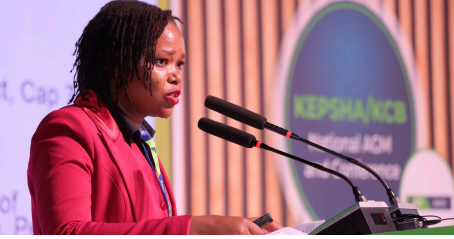
At the Kenya Primary School Heads Association (KEPSHA) National Annual Conference 2025, school leaders from across the country gathered in Mombasa to deliberate on sustainable education, gender equity, and Competency-Based Education (CBE). The event marked a pivotal moment in the national dialogue on how education systems can be truly inclusive and transformative.
The National Gender and Equality Commission (NGEC) Secretary, Dr Purity Ngina, delivered a keynote address that left no room for ambiguity: gender equity is central to Kenya’s educational reform.
“When schools treat all learners fairly, they unleash human potential, strengthen trust, and ensure lasting change,” Dr Ngina emphasized.
Her address, themed “Harnessing Gender Equity as a Catalyst for Systemic Change and CBE Sustainability,” stressed that equity is not a peripheral concern but the foundation upon which the sustainability of CBE and systemic transformation rests.
Despite remarkable strides in enrolment, gender disparities remain entrenched in classrooms across the country. Research by the African Population and Health Research Center (APHRC) highlights that boys and girls continue to experience unequal treatment in learning environments. Disparities manifest in teacher attention, resource allocation, participation in STEM activities, and opportunities for leadership.
Girls in many primary and secondary schools are still underrepresented in science laboratories, leadership roles, and extra-curricular STEM opportunities, while boys are often shielded from engaging in domestic sciences or health-related subjects. These imbalances are compounded by deep-rooted social expectations and unconscious biases that shape teacher behavior and classroom interactions.
Inclusive education is not simply about access to classrooms; it is about ensuring that all learners can participate meaningfully, develop competencies, and exercise agency within the learning process. Without deliberate attention to gender equity, CBE risks becoming a theoretical framework rather than a practical tool for transformation.
Competency-Based Education aims to shift focus from rote learning to skills development, critical thinking, and learner agency. Yet, evidence from Kenyan schools indicates that many educators are ill-equipped to integrate gender responsive teaching methods into CBE. This gap highlights the critical need for teacher training that incorporates awareness of gender dynamics, inclusive pedagogical strategies, and participatory learning techniques.
Dr Ngina underscored that schools must foster environments where gender stereotypes are actively challenged, resources are distributed equitably, and leadership opportunities are accessible to all learners. Creating such inclusive spaces strengthens trust, cultivates confidence, and ensures that every child’s potential is fully realized.
School leadership is central to embedding equity in education. Dr Ngina’s address urged heads of institutions to champion inclusive policies, monitor classroom practices, and lead cultural shifts within schools. By prioritizing equity, school leaders help shape a culture where learning, participation, and achievement are not determined by gender or social background.
Equally important is the integration of equity-focused research and data into decision-making. Monitoring participation rates, performance outcomes, and learner engagement across gender lines ensures that policies are informed by evidence and that systemic gaps are addressed proactively.
The KEPSHA 2025 conference provides an essential platform for policy dialogue, professional collaboration, and shared learning among school leaders and educators. Dr Ngina’s participation reflects the NGEC’s commitment to transforming gender equity from policy rhetoric into practical, measurable outcomes within classrooms.
For Kenya’s education system, sustainability hinges on creating inclusive classrooms, empowering teachers with gender-sensitive tools, and cultivating learning environments where all children—regardless of gender or background—can thrive. Equity is not merely aspirational; it is the cornerstone of effective CBE and the foundation for a more just, capable, and resilient society.