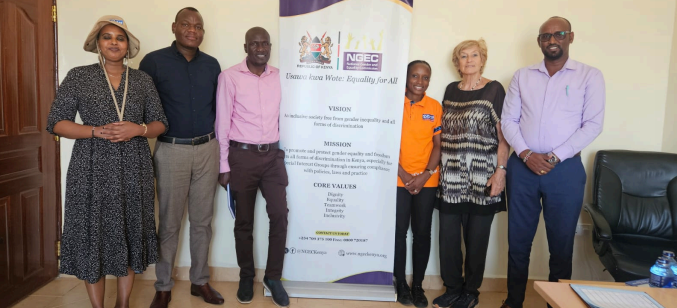
The National Gender and Equality Commission (NGEC) welcomed a delegation from Plan International, led by Ambassador Susan Blankhart, Supervisory Board Member of Plan International Netherlands, on an official visit to Kenya. The engagement, held at NGEC’s Isiolo Regional Office alongside Plan International Kenya’s local team, highlighted a growing commitment to regional collaboration, protection of vulnerable groups, and inclusive governance.
The meeting underscored the strong and sustained collaboration between NGEC and Plan International, which spans both headquarters and regional offices across Kenya. At the center of the discussions was the Horn of Africa Gender-Based Violence Prevention and Response Project, a multi-country initiative currently active in Isiolo and extending into Ethiopia and Somalia. Commission officials and Plan International representatives reflected on strategies for scaling up the project, identified priority areas for joint action, and explored avenues for resource mobilisation to strengthen NGEC’s impact in all 47 counties.
Plan International praised NGEC’s efforts to fortify local governance structures, improve coordination mechanisms, and advance targeted initiatives for Special Interest Groups —including women, youth, persons with disabilities, children, older members of society, minorities, and marginalized communities. These initiatives aim to deliver more inclusive, equitable, and sustainable outcomes.
“Collaborations like this demonstrate that protecting human dignity and promoting inclusive development are achievable when institutions and international partners work together,” Ambassador Blankhart said during the visit.
The Horn of Africa project highlights the transnational nature of GBV, which disproportionately affects women and children in marginalized and conflict-affected regions. Through coordinated prevention efforts, local capacity-building, and community engagement, NGEC and Plan International are working to strengthen early detection, reporting, and response mechanisms across the region.
Locally, the project has focused on awareness campaigns, training for local governance officials, and community-based interventions aimed at empowering survivors and preventing future abuse.
Both NGEC and Plan International emphasised the importance of sustainability and measurable outcomes. By scaling up successful programs and integrating Special Interest Groups into decision-making processes, the partnership aims to ensure that Kenya’s most vulnerable populations are not left behind in social and economic development initiatives. “Partnerships like these reinforce our ability to reach those often excluded, ensuring no one is left behind in Kenya’s development journey,” said a senior NGEC regional official.
The meeting left a clear message: the fight against gender-based violence and inequality is ongoing, and meaningful change requires collaboration, strategic action, and sustained commitment. For NGEC and Plan International, this engagement is more than symbolic—it is a concrete step toward safer communities, stronger governance, and inclusive development across Kenya and the broader Horn of Africa.
The partnership serves as a reminder that gender equality, human rights, and social inclusion are responsibilities shared by all sectors of society— government, international partners, civil society, and citizens alike. As Kenya charts its path toward a more equitable future, initiatives like the NGECPlan International collaboration illustrate the potential of focused, sustained, and communitycentered action to turn policy into real, lasting impact.
Both NGEC and Plan International are committed to accountability and results-driven action. Monitoring and evaluation are central to ensuring programs are not only implemented but also effective, measurable, and sustainable. This includes assessing whether the most vulnerable communities experience tangible improvements in safety, access to services, and participation in local decision-making.