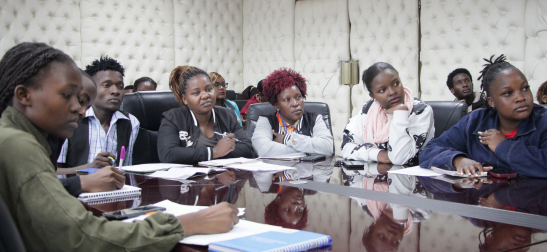
."We are not the leaders of tomorrow— we are the changemakers of today." Those were the resounding words echoed across the main boardroom of the National Gender and Equality Commission (NGEC), as a cross-section of Kenya’s Gen Z youth—unapologetic, informed, and impassioned—stepped up to the microphone. They were not just participants in a forum; they were protagonists in a new national narrative.
In a first-of-its-kind listening and reflection session, NGEC opened its doors and, more significantly, its ears to the pulse of Kenya’s youth. The forum, hosted at the Commission’s headquarters in Nairobi, brought together young people from public and private universities, persons with disabilities (PWDs), youth-led movements, and community advocates from across the country. From impromptu poetry to researched reform proposals, one thing was clear: Kenya’s youth are no longer content with being seen; they demand to be heard.
At the session Hon. Rehema Jaldesa, Chairperson of NGEC, whose attentive presence set the tone for a forum that was both structured and sincere. “This Commission was established to uphold constitutional values for all—especially those often left behind. Today, we reaffirm our commitment to the youth, whose frustrations are real and whose voices must shape policy,” she said.
Held at the Commission’s main boardroom, the forum invited over 60 youth representatives aged 18–34, hailing from all 47 counties. The purpose? To create a safe, official platform for intergenerational dialogue and policy reflection. Unlike traditional town halls or bureaucratic meetings, this was a participatory forum with open-floor sessions, and youth-led panels.
Topics spanned access to education, gender-based violence, mental health, digital equity, climate justice, and representation of PWDs and youth in governance.
Each speaker built upon the last, weaving a powerful tapestry of lived experiences, data-backed analysis, and radical hope. “We are tired of performative inclusion. It’s time for institutions to move beyond tokenism,” said Esther Achieng, a student leader.
In hosting this youth forum, NGEC acted on multiple fronts of its mandate: public participation, monitoring of inclusion policies, mainstreaming youth perspectives, and fostering a culture of respect and constitutionalism.
The Gen Z protests that swept Kenya in mid-2025 were not mere outbursts—they were catalysts for reflection. For many youth, it was the first political action of their lives. For others, it was a continuation of quiet activism finally finding amplification. And for institutions like NGEC, it was a turning point—an opportunity to recenter the people at the heart of public policy.
This shift is more than symbolic. It speaks to a growing demand for lived experience to shape law and governance. It also aligns with Kenya’s constitutional call to public service that is equitable, representative, and transformative.
NGEC’s listening forum is not a stand-alone initiative. It is part of a broader push to embed youth voices in the national agenda. In alignment with Article 55 of the Constitution, the Commission is developing mechanisms to ensure youth access to education, employment, and political inclusion. It is also auditing youth representation in public appointments and has pledged to strengthen accountability structures in counties with persistent marginalisation.
Hon. Rehema Jaldesa, NGEC Chairperson, who anchored the forum not as a distant authority figure, but as a listener — present, attentive, and reflective. “This Commission exists to ensure that no voice is left behind. Today, we are not just listening — we are learning, and we are leading together,” she affirmed.