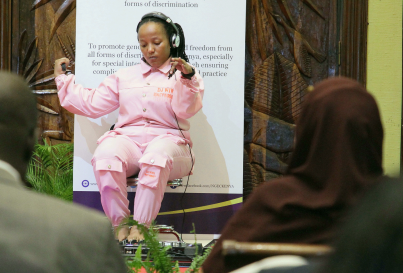
In a bold show of commitment to inclusion and equality, the Commission (NGEC) placed two remarkable individuals at the heart of its high-level Strategic Plan 2025–2029 launch and Usawa Awards celebration: DJ Wiwa and Alan Herbert Onyango. The two, both persons with disabilities and trailblazers in their fields, didn’t just perform they embodied the very values NGEC stands for: dignity, equality, teamwork, integrity, and inclusivity.
The event, held at Nairobi’s Safari Park Hotel, was presided over by the Cabinet Secretary for Gender, Culture and Children Services, Hanna Wendot Cheptumo and attended by Parliamentarians and senior government officials. Notably present was the Government Spokesperson Dr. Isaac Mwaura, a long-time advocate for disability rights and a person with albinism himself. The deliberate choice to spotlight DJ Wiwa as event DJ and Alan Herbert as Master of Ceremonies was more than symbolic it was a living expression of the Commission’s mandate.
Winfred Muchiri, better known as DJ Wiwa, lit up the venue not just with her music, but with her story. Born with cerebral palsy, DJ Wiwa operates her DJ equipment using her feet a sight that defies expectation and redefines excellence. Her playlist set the tone: powerful, uplifting, and relevant, keeping guests on their feet and proving that disability is not inability.
A passionate advocate for women and girls with disabilities, especially around reproductive health and hygiene, DJ Wiwa continues to use her platform to promote visibility, empowerment, and self-expression. Equally compelling was the eloquence and stage presence of Alan Herbert Onyango, the event’s moderator. A seasoned communications professional living with albinism, Alan brought poise, clarity, and warmth to the high-level proceedings. As a TV host, producer, and founder of the Black Albinism Initiative, Alan is no stranger to shaping national conversations around inclusion.
Alan’s moderation carried both depth and ease guiding the flow of the programme while anchoring the core message of the event. He personified NGEC’s values, demonstrating what inclusive representation looks like when integrated not as a favour, but as a norm.
Dr. Mwaura, who has worked closely with the Commission over the years, commended NGEC’s choice to platform DJ Wiwa and Alan Herbert. He noted the Commission’s consistent record in walking the talk on disability inclusion.
“This is not charity. This is not tokenism. This is what empowerment looks like in practice,” he said. Indeed, the event sent a strong and deliberate message: that Kenya's future must be shaped by all its people. From the music to the messages, the launch was a celebration of ability, resilience, and leadership where those who are often spoken about got the space to speak for themselves and shape the national agenda. By giving the stage literally and symbolically to DJ Wiwa and Alan Herbert, NGEC demonstrated that its values are more than words on paper. They are the foundation of how the Commission works, engages, and leads.
The launch of the Strategic Plan 2025–2029 and the Usawa Awards was not just an unveiling of policy or recognition of progress. It was an honest and inspiring glimpse of what an inclusive Kenya can and should look like where talent rises, barriers fall, and all voices are heard.
As the last note played and the final applause rang out, one thing was clear: inclusion, when made real, has the power to transform not only events but hearts, minds, and systems. DJ Wiwa and Alan Herbert didn’t just headline the launch. They made history with it.